

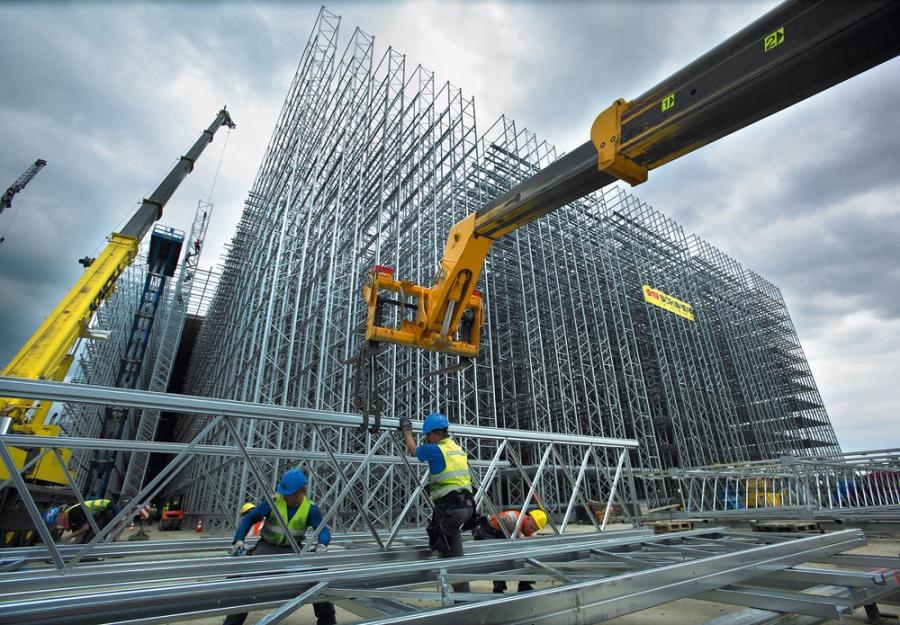
A few decades ago, replacing a busy highway overpass in an American metro area meant setting up concrete barriers, narrowing four lanes to two, and asking commuters to tolerate eighteen months of gridlock. Today, state transportation engineers can demolish an aging span on a Friday night, roll a newly fabricated bridge deck into position on self-propelled transporters by Saturday afternoon, and reopen the interstate before Monday morning rush hour.
That shift captures a broader transformation underway across heavy civil and commercial construction. Modular building methods have outgrown their old reputation for temporary classrooms and bare-bones jobsite trailers. Across the United States, public agencies, utility providers, and private developers are turning to off-site fabrication to build airport concourses, water treatment facilities, rail stations, power substations, and hyperscale data centers. By moving complex assembly out of unpredictable outdoor environments and into controlled manufacturing plants, infrastructure leaders are cutting schedules, tightening quality tolerances, and reducing the disruption that megaprojects routinely inflict on surrounding communities.
Why Traditional Site-Built Infrastructure Is Hitting a Wall
Conventional stick-built construction relies on a linear sequence. Crews clear and grade land, pour foundations, wait for concrete to cure, erect structural steel, and then coordinate dozens of specialty trades working on top of one another in tight spaces. When rain floods an excavation pit or a subcontractor falls two weeks behind, every downstream trade stalls.
Several converging pressures have made that linear model increasingly difficult to sustain on major infrastructure investments. First, the domestic construction industry faces a persistent shortage of experienced electricians, welders, pipefitters, and heavy equipment operators. Recruiting skilled tradespeople to remote energy corridors or high-cost urban cores drives labor budgets sharply higher and stretches project timelines.
Second, the economic cost of downtime has grown too steep to ignore. Shutting down an active airport runway, a major freight rail line, or a congested highway interchange ripples through regional supply chains immediately. Public patience for multi-year construction zones is thin, and private owners financing multi-billion-dollar facilities cannot afford carrying costs that balloon because of winter weather delays.
Modular construction solves the sequencing bottleneck through parallel execution. While civil crews prepare foundations, utilities, and grading on-site, factory teams fabricate structural modules, mechanical rooms, and precast elements simultaneously under a roof. When the ground is ready, finished components arrive in precise order for rapid installation.
Five Modular Trends Reshaping Major Infrastructure Projects
What separates today’s infrastructure prefabrication from earlier efforts is scale and engineering sophistication. Rather than building simple empty shells, manufacturers now deliver fully integrated, high-performance systems tailored for demanding operational environments.
Accelerated Bridge Construction and Transit Upgrades
State departments of transportation have become some of the most aggressive adopters of modular civil engineering through Accelerated Bridge Construction. Instead of forming and pouring concrete piers, abutments, and bridge decks piece by piece above live traffic, contractors cast high-strength structural segments in specialized yards miles away from the highway.
Using heavy cranes or Self-Propelled Modular Transporters, crews slide entire bridge superstructures into place during short overnight or weekend closures. Transit agencies apply the same logic to commuter rail platforms, pedestrian skybridges, and tunnel liner segments. Beyond sparing drivers months of detours, keeping workers off narrow highway shoulders and away from active tracks produces a measurable drop in roadside safety incidents.
Pre-Integrated MEP Racks and Modular Power Infrastructure
Some of the most expensive and error-prone work inside modern infrastructure happens out of sight inside mechanical, electrical, and plumbing networks. Wiring switchgear, welding high-pressure piping, and balancing cooling systems inside cramped jobsite corridors invites installation mistakes and endless punch-list rework.
To eliminate that friction, industrial builders increasingly rely on pre-fabricated MEP racks and containerized utility skids. Nowhere is this trend more visible than in data centers, clean energy projects, and municipal water plants. Entire electrical substations, backup generator enclosures, chiller plants, and membrane filtration skids are assembled, wired, and plumbed inside a factory. Crucially, engineers run full Factory Acceptance Testing before the module ever loads onto a flatbed truck. Catching a faulty relay or a pressure leak on a shop floor takes hours to fix; discovering the same flaw during final site commissioning can delay an entire facility opening by weeks.
Design for Manufacture and Assembly Driven by Digital Modeling
Modular infrastructure only works when a sixty-ton steel and concrete assembly built in Ohio bolts cleanly onto anchor bolts poured in Virginia. Achieving that level of fit requires leaving traditional two-dimensional blueprints behind in favor of Design for Manufacture and Assembly (DfMA) paired with advanced Building Information Modeling.
Engineering teams now build comprehensive digital twins long before fabrication begins. Using clash-detection software and laser scanning of existing site conditions, designers verify clearances down to the millimeter. Those digital models feed directly into automated factory machinery, including CNC plasma cutters, robotic welders, and automated rebar benders. The result is manufacturing-grade precision across massive civil structures, drastically reducing field cutting, welding adjustments, and wasted materials.
Advanced Materials Built for Transport and Longevity
Shipping oversized modules across public highways introduces strict weight and dimension limits. Material science is evolving rapidly to make large-scale components lighter to transport without sacrificing structural durability.
A prime example is the expanded use of Ultra-High-Performance Concrete in modular bridge joints. Historically, engineers worried that connecting separate precast bridge deck panels created weak seams vulnerable to water intrusion and freeze-thaw cracking. Filling those narrow closure joints with ultra-high-performance concrete creates a bond stronger than the surrounding deck panels, turning modular pieces into a monolithic structure engineered to last seventy-five years or more. Elsewhere, hybrid frames combining structural steel, lightweight composite decking, and engineered timber allow designers to span wide spaces in transit hubs and civic terminals while keeping shipping weights manageable for standard cranes.
Phased Modular Growth for Airports, Ports, and Campuses
Major public assets rarely remain static after opening day. Passenger traffic climbs, cargo volumes shift, and hospital networks expand specialty wings. Traditional construction forces owners either to overbuild capacity twenty years in advance or to tear apart active terminals during disruptive renovations.
Modular architecture introduces plug-and-play scalability. Airport authorities can install prefabricated passenger boarding corridors, security checkpoints, and central utility modules while adjacent gates stay fully operational. Port operators deploy modular shore-power systems and prefabricated customs inspection facilities that can be relocated as terminal layouts evolve. For infrastructure owners managing tight capital budgets, the ability to add capacity in predictable increments turns rigid physical assets into adaptable systems.
Real-World Hurdles That Still Challenge Modular Adoption
Despite clear schedule and quality advantages, modular infrastructure is not a universal shortcut. Organizations that underestimate its logistical and organizational demands often watch anticipated savings evaporate quickly.
Heavy-haul transportation and site staging remain major constraints. Moving wide or heavy modules across state lines requires multi-jurisdictional oversize permits, bridge weight clearances, utility line escorts, and carefully timed nighttime deliveries. If a project sits inside a dense downtown district with tight street corners and limited crane laydown space, shipping costs and rigging complexity can outweigh the efficiencies gained on the factory floor.
Early design discipline presents an equally stubborn hurdle. In traditional construction, project owners often tweak room layouts, equipment specs, or finishes well after ground has been broken. Modular workflows leave almost no room for late mind-changing. Once factory fabrication begins, a minor specification revision can ripple across dozens of identical modules and trigger steep change orders. Teams must lock down decisions months earlier than they are accustomed to doing.
Regulatory fragmentation also adds friction across the United States. Building codes, welding certifications, and electrical inspection protocols vary significantly from one state or municipality to the next. When a mechanical module arrives sealed from an out-of-state manufacturing facility, local inspectors may hesitate to sign off on concealed wiring or plumbing unless third-party inspection programs and interstate reciprocity agreements were established before production started.
How Owners Are Rewiring Procurement for Modular Success
Capturing the full value of off-site fabrication requires changing how infrastructure projects are contracted and financed. Traditional design-bid-build procurement, where an architect finishes drawings in isolation before awarding construction to the lowest bidder, works poorly for modular delivery. By the time a fabricator sees the plans, structural dimensions rarely match efficient shipping envelopes or standard factory tooling, forcing expensive redesigns.
Forward-thinking agencies and corporate owners are shifting toward collaborative models such as progressive design-build and Construction Manager at Risk. Bringing general contractors and modular manufacturers into schematic design allows teams to standardize repeatable elements early, optimize module dimensions for highway transit, and price fabrication accurately before committing capital.
Financial structures are evolving alongside contracts. Because factory work requires purchasing steel, electrical gear, and specialized components much earlier than traditional field schedules, lenders and public finance officers have had to update payment milestones. Structuring clear off-site material verification, title transfers, and bonded factory deposits ensures cash flows smoothly to manufacturers while protecting the owner’s balance sheet.
Where Modular Infrastructure Goes From Here
Environmental mandates are giving off-site construction an additional tailwind. Controlled factories dramatically cut jobsite scrap by ordering materials to exact dimensions and recycling steel, gypsum, and concrete offcuts directly inside the plant. Consolidating hundreds of individual trade deliveries into scheduled module shipments also lowers diesel emissions and eases traffic around crowded urban corridors.
As aging highways, overburdened power grids, and expanding digital networks force unprecedented investment across North America, the construction sector cannot rely solely on yesterday’s field-built habits to meet the workload. Treating major public and industrial assets with the precision, repeatability, and quality control of advanced manufacturing is no longer an experiment reserved for niche pilot projects. For infrastructure leaders tasked with delivering durable assets faster and with fewer surprises, modular construction has become an essential strategic discipline.